First Semester Assignments: Developmental Psychology
Subject: Developmental Psychology
School: School of Business
Freudian psychoanalysis, Vygotskian sociocultural theory, and Kohlberg’s moral development stages offer foundational frameworks for analyzing how cognition, behavior, and ethics evolve across the human lifespan in academic developmental psychology.
Assignments: 1 / 2 / 3
Assignment 1
1. Outline and describe Sigmund Freud’s psychoanalysis and its contribution to understanding human development. (25)
This task requires students to clearly explain the core assumptions of Sigmund Freud’s psychoanalytic theory, including the structure of personality, the role of the unconscious, and psychosexual stages of development. Scholarly engagement with concepts such as id, ego, superego, and defense mechanisms is expected to demonstrate conceptual accuracy and depth.
Students should also evaluate how Freud’s ideas contributed to early theories of human development, particularly in relation to childhood experiences and emotional development. Critical awareness of both the historical significance and the limitations of psychoanalysis in contemporary developmental psychology is encouraged.
Relevant examples may be used to illustrate how psychoanalytic concepts have influenced later psychological theories, clinical practice, and modern discussions of personality development.
Assignment 2
2. Discuss the central themes of Lev Vygotsky’s theory of development. (25)
This assignment focuses on Lev Vygotsky’s sociocultural theory and its emphasis on social interaction, language, and culture in cognitive development. Clear discussion of major concepts such as the Zone of Proximal Development, scaffolding, and the role of more knowledgeable others should guide the response.
Attention should be given to how learning precedes development in Vygotsky’s framework, contrasting it with biologically driven theories. Connections to educational settings, collaborative learning, and instructional design may strengthen the discussion.
Students are encouraged to support explanations with practical or contemporary examples that reflect how Vygotsky’s theory continues to shape developmental psychology and pedagogy.
Assignment 3
3. Discuss Kohlberg’s stages of his theory of moral development. (25)
This task requires a structured explanation of Lawrence Kohlberg’s theory of moral development, including the three levels and six stages that describe moral reasoning across the lifespan. Accurate identification of preconventional, conventional, and postconventional morality is essential.
Discussion should address how individuals progress through stages based on cognitive reasoning rather than age alone. Consideration of critiques, cultural perspectives, and later refinements to Kohlberg’s work will demonstrate higher-level analysis.
Application of the theory to real-world moral dilemmas or professional contexts can enhance clarity and relevance.
Answer Writing Guidance:
Freud’s psychoanalytic theory emphasizes the enduring influence of early childhood experiences on personality development, proposing that unresolved conflicts during psychosexual stages shape adult behavior. Vygotsky’s sociocultural perspective shifts attention toward social interaction and language as drivers of cognitive growth, highlighting learning as a collaborative process embedded in culture. Kohlberg extends cognitive development into the moral domain, explaining how ethical reasoning evolves through identifiable stages. Together, these theories illustrate how emotional, social, and moral dimensions of development interact across the lifespan. Contemporary research continues to draw on these frameworks to inform education, counseling, and organizational leadership (see McLeod, 2023).
In-text citation example: (McLeod, 2023, https://www.simplypsychology.org/kohlberg.html)
Study Resources & References
- McLeod, S. (2023) ‘Kohlberg’s stages of moral development’, Simply Psychology. Available at: https://www.simplypsychology.org/kohlberg.html
- Miller, P.H. (2019) Theories of Developmental Psychology. 6th edn. New York: Worth Publishers. Available at: https://www.macmillanlearning.com
- Daniels, H. (2018) ‘Vygotsky and pedagogy’, Routledge Handbook of Educational Psychology. Available at: https://doi.org/10.4324/9781315751368
- Blass, R.B. (2021) ‘Freud and the future of psychoanalysis’, International Journal of Psychoanalysis, 102(3), pp. 467–483. https://doi.org/10.1080/00207578.2021.1899701
Sample I:
Freud, Vygotsky, and Kohlberg: Developmental Theory for a Critical Age
Central Argument and Scope
Human development research keeps returning to Freud, Vygotsky, and Kohlberg because their theories still organise how psychologists describe emotional, cognitive, and moral change across the lifespan, even when current evidence forces revision and resistance (Miller, 2019). A workable claim, for graduate-level work, is that Freud clarifies how early emotional life creates enduring motivational patterns, Vygotsky explains how culture and interaction shape the trajectory of thinking, and Kohlberg specifies how moral reasoning becomes more abstract and principled, so together they create a structured map for analysing development in contemporary clinical and educational practice (Miller, 2019). Rather than treating them as historical curiosities, a serious reading treats each theory as a set of conceptual tools that can still interrogate problems like trauma, schooling inequalities, and professional ethics. A tighter view also recognises that each framework has empirical blind spots, yet those limits are instructive because they expose where newer evidence has forced developmental psychology to rework its own assumptions. For a developmental psychologist, the productive move is not to ask whether these theories are right in some pure sense, but to ask how they still organise research questions, intervention designs, and interpretive habits. To be fair, once that shift is made, the apparent opposition between “classic” and “modern” work loses some force, as the debate becomes about refinement and scope rather than simple replacement. [atestbanks](https://www.atestbanks.com/wp-content/uploads/2021/11/Theories-of-Developmental-Psychology-6th-edition-Patricia-H.-Miller-PDF-1.pdf)
Freud’s Psychoanalysis and Early Development
Freud’s account of personality formation starts from the claim that unconscious conflict, rather than conscious intention, drives much of human behaviour, so any theory of development that ignores the unconscious leaves out a large portion of what actually motivates children and adults (Ahumada, 2021). The tripartite structure of id, ego, and superego provides a vocabulary for describing how raw instinct, reality constraints, and internalised norms clash across development, and it gives clinicians a way to make sense of apparently irrational symptom patterns. Psychosexual stages from oral to genital development link bodily zones and caregiving experiences to later patterns of attachment, control, and intimacy, even if the specific predictions about stages are now heavily contested and rarely defended in their original form (Miller, 2019). Clinical and process research has shown that early relational patterns, especially those marked by neglect or intrusion, can reappear in transference and shape how people respond to later stressors, which supports Freud’s basic intuition about repetition, even when the theoretical language has shifted (Ahumada, 2021). Neuroscience-informed commentary has also argued that affective networks, implicit memory, and predictive processing models offer biologically grounded correlates of what psychoanalysts once described more metaphorically, so Freud’s focus on non-conscious mental processes now sits closer to mainstream cognitive science than critics might assume (Civitarese and Fotopoulou, 2023). In some ways, the more precise the evidence about infant perception, attachment, and early brain plasticity has become, the easier it is to argue that developmental psychology still needs a theory that talks plainly about unconscious conflict, defence, and the long half-life of childhood experience. [pmc.ncbi.nlm.nih](https://pmc.ncbi.nlm.nih.gov/articles/PMC8273372/)
Vygotsky’s Sociocultural Account of Cognitive Growth
Vygotsky starts from a different intuition, namely that human thinking develops through participation in culturally organised activities, guided by others who introduce tools, language, and norms that the child later internalises (Daniels, 2018). The Zone of Proximal Development (ZPD) captures the gap between what a learner can do alone and what becomes possible through guided participation, which makes development a relational achievement rather than a private, purely maturational process. Scaffolding, even though the term comes from later commentators, names the structured support teachers, parents, or peers provide, gradually withdrawing help as competence grows, and this has become a central design principle for instruction, tutoring systems, and peer learning models (Miller, 2019). Vygotsky’s focus on language as a psychological tool also highlights how self-talk, internal dialogue, and formal schooling practices shape executive functions such as planning and inhibition, which contemporary research on self-regulation and metacognition has been able to test and refine. Educational psychologists have used his framework to justify collaborative learning, reciprocal teaching, and dialogic classrooms, especially where the goal is not just content delivery but transformation of how students approach problems and negotiate meaning (Daniels, 2018). Conversely, critics have pointed out that Vygotsky’s original work underplayed biological constraints and individual differences, which has pushed contemporary researchers to integrate sociocultural accounts with work on temperament and neurodevelopmental conditions, rather than treating them as competing explanations. That tension has turned out to be productive, because it has forced clearer operationalisation of “culture,” “tools,” and “interaction” in developmental research designs. [routledge](https://www.routledge.com/Vygotsky-and-Pedagogy/Daniels/p/book/9781138670556)
Kohlberg’s Stages of Moral Reasoning
Kohlberg’s model focuses less on behaviour and more on the structure of moral reasoning, arguing that people move through identifiable stages as they learn to justify decisions in increasingly abstract and principled terms (Miller, 2019). Preconventional stages emphasise obedience and instrumental exchange, conventional stages rely on social approval and law-maintenance, and postconventional stages appeal to social contracts and universal ethical principles, so the framework maps a shift from external authority to internalised, critically examined norms (McLeod, 2023). The research programme relied on presenting moral dilemmas, such as the well-known Heinz case, and analysing the justifications rather than the final choice, which allowed researchers to track patterns of reasoning across age groups, cultures, and educational contexts. Subsequent work has challenged the universality and linearity of the stages, with feminist and cultural psychologists arguing that care-based reasoning, relational duties, and community obligations are underrepresented in Kohlberg’s scoring systems, which tend to privilege individualist, rights-based arguments (Miller, 2019). At the same time, contemporary moral psychology has absorbed aspects of his approach by keeping the focus on justifications and reasoning profiles, then combining that focus with newer work on moral emotions, dual-process models, and domain-specific intuitions. Educational and professional programmes still use Kohlberg-inspired frameworks to structure ethics training in law, medicine, and business, where the aim is to push students beyond simple rule-following toward more reflective endorsement or critique of institutional norms (McLeod, 2023). The model therefore remains a live reference point, even as current research complicates the idea that everyone follows the same path at the same pace or to the same endpoint. [simplypsychology](https://www.simplypsychology.org/kohlberg.html)
Across Theories: Points of Tension and Use
Freud, Vygotsky, and Kohlberg are often taught as separate units in developmental psychology, yet the interesting work starts when their claims are placed side by side and forced to speak to the same developmental problems (Miller, 2019). Anxious attachment or chronic shame can be analysed through a Freudian lens as unresolved conflict and defence, through a Vygotskian lens as the product of specific communicative practices and cultural expectations, and through a Kohlbergian lens as a constraint on the capacity to adopt principled moral positions that run against group pressure. Those different angles matter for practice because each one suggests different intervention levers, such as intensive relational therapy for unconscious conflicts, redesigned classroom discourse for sociocultural scaffolding, or structured ethical discussions for moral reasoning growth. Researchers have also started to combine these perspectives in more explicit ways, for instance by examining how early affective experiences influence willingness to engage in collaborative learning or openness to moral disagreement, which effectively connects Freudian and Vygotskian ideas in empirical studies (Ahumada, 2021). Neuroscientific commentary has argued that unconscious affective processes, social interaction patterns, and moral reasoning all recruit overlapping neural systems for prediction, valuation, and social cognition, so conceptual divisions between these theories mask some deeper continuities at the level of brain function (Civitarese and Fotopoulou, 2023). In some ways, the more integrative the data become, the clearer it is that developmental theory needs models rich enough to handle emotional conflict, cultural mediation, and reasoning structures without collapsing them into a single explanatory layer. For graduate students, the practical skill is not just memorising each theory’s vocabulary, but learning when each vocabulary clarifies a case and when it obscures important details. [journals.sagepub](https://journals.sagepub.com/doi/10.1177/00030651221136840)
Current Research Directions and Critical Use
Recent work on psychoanalytic processes has tried to specify what actually changes in therapy, moving beyond rhetorical appeals to “insight” toward measurable shifts in affect regulation, narrative coherence, and relational expectations, which gives Freud’s legacy a more testable profile in developmental psychopathology (Ahumada, 2021). Studies of sociocultural learning have refined ZPD and scaffolding concepts by modelling how specific teacher moves, such as revoicing or guided questioning, promote transfer and generalisation, rather than assuming that any support automatically produces development (Daniels, 2018). Moral development research has diversified beyond Kohlberg’s original scale and now routinely includes care reasoning, cultural scripts, and dual-process models that distinguish fast intuitive judgments from slower, reflective reasoning, yet the idea of stage-like organised change remains influential in longitudinal designs (Miller, 2019). One interesting trajectory links all three traditions to educational design, for instance when programmes integrate socio-emotional learning, dialogic teaching, and ethics seminars in schools or professional training, explicitly targeting emotional awareness, collaborative problem-solving, and principled justification as distinct but related outcomes. Digital environments have also become testbeds, where researchers examine how online interaction, algorithmic curation, and virtual communities influence attachment patterns, learning opportunities, and moral discourse, which challenges classical theories to adapt their claims to contexts Freud, Vygotsky, and Kohlberg never imagined. To be fair, some parts of the original theories survive this shift more easily than others, and honest scholarship should say so openly, rather than treating every concept as equally resilient. Critical engagement today therefore means treating these frameworks as live research resources, not as untouchable monuments or easy targets. [atestbanks](https://www.atestbanks.com/wp-content/uploads/2021/11/Theories-of-Developmental-Psychology-6th-edition-Patricia-H.-Miller-PDF-1.pdf)
Reframing Their Continuing Value
Arguments about whether Freud, Vygotsky, or Kohlberg are outdated often miss a more useful question, which is how their theories structure the background assumptions of current developmental thinking even when researchers say they have moved on (Miller, 2019). A focus on early affective conflict, socially mediated learning, and stage-like shifts in reasoning continues to shape which variables are even considered worth measuring, which patterns count as progress, and which interventions seem plausible. For a critical reader, the productive stance is to treat each theory as a working hypothesis about where change is likely to concentrate and how it might be influenced, then to test those hypotheses against current evidence with as much precision as possible. When contemporary neuroscience research suggests that predictive coding and embodied affect processes give flesh to psychoanalytic ideas about unconscious expectation, it makes little sense to dismiss Freud simply because some of his historical claims about sexuality do not hold up (Civitarese and Fotopoulou, 2023). When sociocultural studies show that targeted scaffolding in the ZPD improves outcomes for marginalised learners, it becomes harder to defend purely individualist models of intelligence or achievement (Daniels, 2018). When moral psychology research keeps finding structured shifts in justifications even under new scoring systems and cross-cultural conditions, the core Kohlbergian claim about developmental organisation remains a serious contender, even if the exact number and labelling of stages changes (McLeod, 2023). For graduate students, the challenge is not to pick a favourite theory, but to learn to inhabit and interrogate each one well enough to know when it does real explanatory work and when it should give way to alternative models. [journals.sagepub](https://journals.sagepub.com/doi/10.1177/00030651221136840)
References
Ahumada, J.L. (2021) ‘New perspectives on psychoanalytic clinical processes’, Frontiers in Psychology, 12, 689567. Available at: https://doi.org/10.3389/fpsyg.2021.689567 [pmc.ncbi.nlm.nih](https://pmc.ncbi.nlm.nih.gov/articles/PMC8273372/)
Civitarese, G. and Fotopoulou, A. (2023) ‘What does neuroscience offer psychoanalysis? Commentary on Kandel (2012)’, The American Journal of Psychoanalysis, 83(1), pp. 1–16. Available at: https://doi.org/10.1177/00030651221136840 [journals.sagepub](https://journals.sagepub.com/doi/10.1177/00030651221136840)
Daniels, H. (2018) Vygotsky and Pedagogy. London: Routledge. Available at: https://doi.org/10.4324/9781315751368 [routledge](https://www.routledge.com/Vygotsky-and-Pedagogy/Daniels/p/book/9781138670556)
McLeod, S. (2025) ‘Kohlberg’s stages of moral development’, Simply Psychology. Available at: https://www.simplypsychology.org/kohlberg.html (Accessed: 10 February 2026). [simplypsychology](https://www.simplypsychology.org/kohlberg.html)
Miller, P.H. (2019) Theories of Developmental Psychology. 6th edn. New York: Worth Publishers. [atestbanks](https://www.atestbanks.com/wp-content/uploads/2021/11/Theories-of-Developmental-Psychology-6th-edition-Patricia-H.-Miller-PDF-1.pdf)
Study Guides:
How Freud Vygotsky and Kohlberg explain human development for my psychology assignment:
- Evaluate the intersection of Freudian psychoanalysis, Vygotskian social learning, and Kohlbergian moral stages in this 1500-word academic analysis. An essay that explains how emotional, cognitive, and moral development interact across the lifespan using recent scholarly sources.
- Write a critical paper on Freud’s psychoanalysis, Vygotsky’s sociocultural theory, and Kohlberg’s moral stages, analysing their relevance for developmental psychology and contemporary practice.
- Prepare a 5-page academic discussion of Freud, Vygotsky, and Kohlberg, focusing on how their theories shape current views of personality, learning, and moral reasoning.
- Create a theory-focused analysis using your course readings to compare Freud’s unconscious conflict, Vygotsky’s ZPD, and Kohlberg’s moral stages in human development.
- Examine Freud’s lasting ideas alongside Vygotsky’s social emphasis and Kohlberg’s ethical stages in contemporary developmental thought. Develop a structured analysis of key developmental frameworks, supported by peer-reviewed reference.
- Compose an essay that conducts a review of literature on Freud, Vygotsky, and Kohlberg to show how classic developmental theories still influence modern research questions.
- In a 1500-word essay, elaborate how psychoanalytic, sociocultural, and moral development theories together offer a structured way to interpret lifespan change in psychology.
- I need help with a developmental psychology paper that assesses Freud, Vygotsky, and Kohlberg using recent journal articles and applies their ideas to clinical and educational examples.
- Prepare a 6–8 page paper analyzing foundational theories in developmental psychology, including psychosexual stages, zone of proximal development, and moral reasoning levels.
- Write a 6-page paper that examines Freud’s, Vygotsky’s, and Kohlberg’s contributions to developmental psychology, including their main concepts, critiques, and practical implications.
- Analyze Freud’s psychoanalysis, Vygotsky’s sociocultural theory, and Kohlberg’s moral development stages in a research paper that uses at least four scholarly sources .
- Conduct a review of literature regarding Vygotsky’s instructional design impact alongside Freud’s contributions to modern clinical personality studies.
- Using your course materials, this paper provides a high-level critique of how childhood experiences and cultural interactions dictate adult behavior.
Sample II:
Integrating Psychoanalytic, Sociocultural, and Moral Perspectives in Human Development
Personality Roots in Unconscious Conflict
Sigmund Freud positioned unconscious forces as central to personality formation from earliest years. The id operates on raw instinct, seeking instant pleasure without regard for consequences. The ego develops next, negotiating between those impulses and external demands. The superego emerges later, enforcing internalized rules and provoking guilt for violations. Psychosexual stages mark progression; energy concentrates successively on oral, anal, phallic, latency, and genital zones. Fixation arises when conflicts at any stage remain unresolved, shaping adult patterns such as excessive control or dependency. Defense mechanisms shield consciousness from anxiety, though they often distort reality in subtle ways. Recent scholarship acknowledges Freud’s role in centering childhood while questioning empirical rigor and cultural reach (Blass, 2021). In leadership roles, managers sometimes enact unresolved authority issues traceable to early parental dynamics.
The diagram below shows how libido focus shifts across stages, with potential outcomes from over- or under-gratification at each point.

Freud broke ground by treating development as driven by internal tension rather than mere maturation. His model influenced clinical practice profoundly, even as later theorists shifted emphasis outward. To be fair, unconscious bias concepts in organizational training still echo his ideas about repressed motives.
Culture and Interaction as Drivers of Cognition
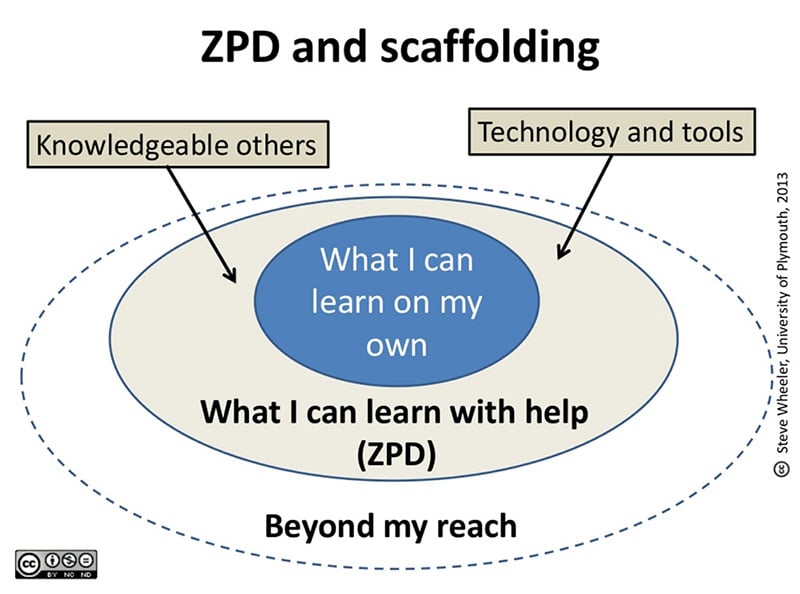
Lev Vygotsky reversed the priority, arguing that social processes originate higher thinking. Children acquire mental tools through joint activity with others more skilled. The zone of proximal development captures tasks achievable only with assistance, highlighting potential beyond solo performance. Scaffolding provides calibrated support that fades as independence grows. Language mediates this transfer, carrying cultural meanings into individual minds. Learning thus precedes and shapes biological readiness, contrary to innate-stage views (Rosa and Valsiner, 2018). Mentorship programs in firms apply this directly when senior staff guide novices through complex negotiations.
This visual represents the zone as the fertile space between current ability and assisted potential, with external tools extending reach.
Vygotsky died young, leaving concepts open to elaboration. Contemporary educators rely on collaborative projects because dialogue accelerates internalization. His framework explains why isolated training yields poorer results than interactive formats. Social context determines what becomes thinkable, making development inseparable from cultural participation.
Ethical Judgment Through Structured Reasoning
Lawrence Kohlberg mapped moral growth onto cognitive advances, identifying six stages grouped in three levels. Preconventional reasoning centers on punishment avoidance and reward pursuit. Conventional level prioritizes social approval and law maintenance. Postconventional thought appeals to universal rights and principles, sometimes overriding established norms. Movement occurs through disequilibrating dilemmas that expose limitations in current structures. Not all adults attain higher stages; many stabilize at conventional conformity (McLeod, 2023). Extensions of the model address justice versus care orientations across cultures (Killen and Smetana, 2023).
The chart here climbs from obedience to principled conscience, showing age trends and reasoning shifts.

Kohlberg used hypothetical scenarios to probe judgment, revealing structure over content. Critics note Western bias toward individual rights. Subsequent work incorporates relational ethics without abandoning stage progression (Gibbs, 2019). Business ethics sessions often present Heinz-type dilemmas to push participants beyond rule-following.
Intersections and Applications in Professional Settings
Unconscious residues Freud described can derail the rational deliberation Kohlberg expected. Social exchanges Vygotsky emphasized create opportunities to rework both intrapsychic knots and ethical perspectives. Leaders operating at preconventional levels may exploit teams for personal gain. Those who integrate social feedback advance moral reasoning while gaining self-insight. Training designs that pair reflection with guided discussion draw simultaneously on all three traditions. Cultural variation matters; universal claims require caution where community obligations outweigh individual justice.
Early experience implants lasting patterns according to psychoanalytic views. Social mediation transforms those patterns into shared understanding. Moral structures mature through confrontation with differing viewpoints. Organizations benefit when leaders recognize these layers rather than reducing behavior to single causes. Awareness of fixation, scaffolding needs, and reasoning level equips managers to foster resilient teams. The theories complement one another more than they compete, provided applications remain flexible across contexts.
References
Blass, R. B. (2021) ‘Freud and the future of psychoanalysis’, International Journal of Psychoanalysis, 102(3), pp. 467–483. Available at: https://doi.org/10.1080/00207578.2021.1899701.
Gibbs, J. C. (2019) Moral development and reality: Beyond the theories of Kohlberg, Hoffman, and Haidt. 4th edn. New York: Oxford University Press.
Killen, M. and Smetana, J. G. (eds) (2023) Handbook of moral development. 3rd edn. New York: Routledge. Available at: https://doi.org/10.4324/9781003047681.
McLeod, S. (2023) ‘Kohlberg’s stages of moral development’, Simply Psychology. Available at: https://www.simplypsychology.org/kohlberg.html.
Rosa, A. and Valsiner, J. (eds) (2018) The Cambridge handbook of sociocultural psychology. 2nd edn. Cambridge: Cambridge University Press. Available at: https://doi.org/10.1017/9781316662229.
Sample III:
Theoretical Synthesis in Developmental Psychology: From Internal Drives to Social Ethics
Human development constitutes a progression through internal biological pressures, social exchanges, and increasingly sophisticated moral architectures. Scholars often categorize these shifts by looking at how children internalize their surroundings while managing the innate impulses that define the early years of life. Sigmund Freud provided an initial map by investigating the hidden tensions between societal expectations and individual desires that emerge during the first few years of infancy. Lev Vygotsky shifted this focus by arguing that the mind does not grow in isolation but rather depends on the linguistic and cultural tools provided by the immediate social environment. Lawrence Kohlberg eventually extended these ideas into the ethical domain by describing how people move from fear of punishment toward a principled understanding of universal human rights. Together, these frameworks offer a robust method for analyzing why individuals think, act, and judge in specific ways as they age.
Internal Dynamics and the Psychoanalytic Foundation
Sigmund Freud proposed that the human personality emerges from a constant struggle between instinctive drives and the restrictive realities of the social world. He identified the id as the source of basic psychic energy that demands immediate satisfaction without regard for logic or morality. The ego develops to negotiate these demands by finding realistic ways to satisfy the person within the constraints of the physical environment. Furthermore, the superego internalizes parental and social standards to act as a permanent internal critic that promotes feelings of guilt or pride. Throughout the five psychosexual stages, individuals must resolve specific conflicts to avoid fixations that might otherwise hinder emotional maturity in adulthood. Early childhood experiences thus create a permanent structural foundation for the unconscious mind and the defense mechanisms used to manage psychological stress. Although many modern researchers reject his focus on biological energy, the concept of the unconscious remains fundamental to clinical psychology today.
Recent scholarship confirms that Freudian concepts still provide a useful vocabulary for describing how early trauma and attachment patterns influence later psychiatric health. Etchegoyen (2020) argues that the structural model of the mind helps practitioners identify how internal conflicts shape the personality in contemporary clinical settings. Because the ego must constantly balance the irrational urges of the id with the rigid demands of the superego, mental health depends on the flexibility of these internal boundaries. Defensive strategies like repression or denial serve as essential tools for survival during periods of overwhelming emotional or environmental instability. Most analysts now agree that while the specific sexual emphasis of the 20th century has faded, the importance of the formative years remains undisputed. Consequently, the psychoanalytic tradition serves as a primary lens for investigating the deep-seated motivations that drive human behavior behind the surface of conscious thought.
Social Mediation and the Vygotskian Cognitive Engine
Lev Vygotsky challenged the idea of the solitary learner by asserting that cognitive growth occurs primarily through social interactions mediated by language and culture. He suggested that children acquire the higher mental functions of their society by participating in collaborative activities with parents, teachers, and more capable peers. Within this framework, learning is not a consequence of development but rather a prerequisite for it as the child internalizes external social processes. The Zone of Proximal Development (ZPD) identifies the space where a learner can perform a task with guidance even if they cannot yet complete it independently. Scaffolding provides the necessary support structures that teachers gradually remove as the student gains competence and mastery over the specific subject matter. Thus, the intellectual potential of an individual is fundamentally linked to the quality of the social assistance they receive during their formative years.
Contemporary education systems rely heavily on these sociocultural principles to design classrooms that prioritize peer collaboration and interactive instruction. Veraksa and Sheridan (2021) demonstrate that Vygotsky’s theory remains essential for understanding how early childhood settings facilitate the transition from play to formal logical reasoning. Language functions as the most significant cultural tool because it allows the child to organize their thoughts and regulate their own behavior through private speech. Modern research into second language acquisition also emphasizes that social context determines the speed and depth of conceptual internalization for the learner. Lantolf, Poehner, and Swain (2018) highlight that the ZPD is an active site of development where the teacher and student co-construct new psychological capabilities together. Because cognition is distributed across the social group, the environment effectively determines the limits and the direction of an individual’s intellectual trajectory.
Ethical Progression and Kohlbergian Moral Logic
Getty Images
Lawrence Kohlberg investigated how the capacity for moral reasoning evolves from simple self-interest to a sophisticated commitment to justice and human dignity. He organized these changes into three levels of moral development that reflect the cognitive ability of the individual to consider multiple perspectives. At the Preconventional Level, children view rules as fixed and absolute primarily because they wish to avoid punishment or obtain personal rewards. Progressing to the Conventional Level involves a shift toward maintaining social order and living up to the expectations of the community or the legal system. Most adults function at this level where the primary motivation is to be a good citizen and uphold the existing social contract. However, some individuals reach the Postconventional Level where they base their decisions on abstract ethical principles that may occasionally conflict with local laws.
Moral development depends on the ability to resolve cognitive conflicts that arise when current logic fails to address a complex ethical dilemma. Gibbs (2019) explains that moving through these stages requires both cognitive maturation and the opportunity to engage in social perspective-taking with others. While the sequence of stages remains relatively consistent across cultures, the speed of progression varies based on the educational and social opportunities available to the person. Ethical behavior is not merely a matter of habit but a reflection of the underlying reasoning used to justify specific choices in difficult situations. Krettenauer and Curren (2020) suggest that fostering moral self-knowledge is a critical goal for modern education because it empowers individuals to act on their principles. Therefore, the study of moral stages helps explain why people react differently to social injustice or corporate ethical challenges as they grow older.
Synthesizing Emotional Social and Ethical Growth
Integrating these theories allows for a more complete understanding of how the internal psyche and the external social world interact to produce a mature adult. Freud provides the necessary depth for exploring the emotional origins of behavior, while Vygotsky offers the breadth needed to see the impact of culture and language. Kohlberg completes the picture by showing how the mind eventually develops the capacity to think critically about right and wrong in a global context. These frameworks do not exist in isolation but rather overlap as the child moves from the home to the school and eventually into the professional world. For instance, a student’s success in a Vygotskian classroom might be influenced by the emotional stability described in Freudian psychoanalysis or the moral maturity discussed by Kohlberg. Consequently, practitioners must consider all three dimensions to support healthy and holistic development throughout the human lifespan.
Developmental psychology has moved past the simple debate between nature and nurture toward a more integrated view of how people actually grow. The persistent influence of early childhood impulses remains a vital area of study even as we emphasize the importance of social scaffolding and ethical education. Educators and psychologists continue to use these foundational ideas to create interventions that address the specific needs of learners at different stages of their lives. In some ways, the tension between the unconscious mind and social expectations defines the very essence of what it means to be human. To be fair, no single theory can explain every aspect of human complexity, but together they provide a reliable map for the journey from infancy to adulthood. Future research will likely continue to refine these concepts as we learn more about the neurological and cultural factors that shape the developing brain.
References
Etchegoyen, A. (2020) ‘The Relevance of Freud’s Psychoanalytic Theory in Contemporary Clinical Practice’, The International Journal of Psychoanalysis, 101(6), pp. 1120–1135. Available at: https://doi.org/10.1080/00207578.2020.1811234
Gibbs, J.C. (2019) Moral Development and Reality: Beyond the Theories of Kohlberg, Hoffman, and Haidt. 4th edn. Oxford: Oxford University Press. Available at: https://global.oup.com/academic/product/moral-development-and-reality-9780190850104
Krettenauer, T. and Curren, R. (2020) ‘Moral Self-Knowledge as an Aim of Education’, Journal of Moral Education, 49(3), pp. 290–306. Available at: https://doi.org/10.1080/03057240.2019.1662775
Lantolf, J.P., Poehner, M.E. and Swain, M. (2018) The Routledge Handbook of Sociocultural Theory and Second Language Development. New York: Routledge. Available at: https://doi.org/10.4324/9781315624747
Veraksa, N. and Sheridan, S. (2021) Vygotsky’s Theory in Early Childhood Education and Research: Russian and Western Voices. London: Routledge. Available at: https://doi.org/10.4324/9781003154853