MSLOD LED 8920 & QTY 8920 Applied Project Assessment 3: Individual Report WIN2026 | Abu Dhabi
| Assessment Type | Individual Report |
|---|---|
| Assessment Title | Assessment 3 |
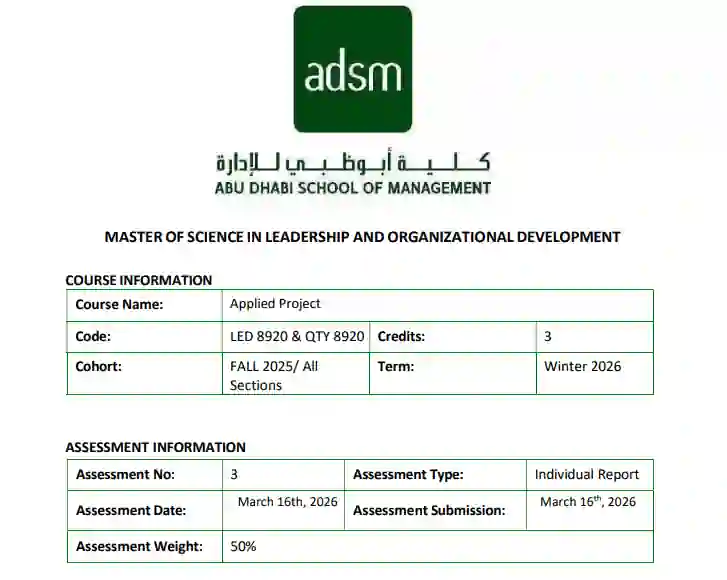
MASTER OF SCIENCE IN LEADERSHIP AND ORGANIZATIONAL DEVELOPMENT
COURSE INFORMATION
|
Course Name: |
Applied Project |
||
|
Code: |
LED 8920 & QTY 8920 |
Credits: |
3 |
|
Cohort: |
FALL 2025/ AllSections |
Term: |
Winter 2026 |
ASSESSMENT INFORMATION
|
Assessment No: |
3 |
Assessment Type: |
Individual Report |
|
Assessment Date: |
March 16th, 2026 |
Assessment Submission: |
March 16th, 2026 |
|
Assessment Weight: |
50% |
||
1.Introduction
This final assessment requires students to develop a comprehensive Applied Business Project that addresses a real organizational challenge within a contemporary UAE business context. The report must demonstrate the ability to appraise and define complex organizational problems, apply structured and advanced analytical approaches, synthesize contextual evidence, and formulate practical, evidence- based recommendations grounded in leadership and organizational development theory. This assessment consists of questions that test your knowledge and skills in the Applied Project you acquired during the course. This assessment is in a business applied project report you will submit through LMS.
2.Course Learning Outcomes:
In this assessment, you should be able to:
|
# |
CLOs |
PLO1 |
PLO2 |
PLO3 |
PLO4 |
PLO5 |
PLO6 |
QFE |
|
CLO1 |
Appraise current issues and complex organizational problems to identify and define the project scope. |
X |
X |
|
|
|
X |
K,S,R |
|
CLO3 |
Critically apply advanced analytical skills to synthesize evidence and contextual knowledge. |
X |
|
|
X |
|
|
|
|
CLO4 |
Formulate practical, evidence-based recommendations and solutions. |
|
X |
|
|
X |
X |
|
|
CLO5 |
Communicate project outputs clearly to professional and academic audiences using appropriate conventions. |
|
|
X |
|
|
X |
|
3.Business Report
3.1 Assessment Requirement:
Students are required to produce an individual Applied Project Report addressing a current and complex organizational issue within a UAE workplace, sector, or industry context. The report must demonstrate the ability to appraise and define a strategically relevant organizational problem, apply advanced analytical skills to synthesize contextual evidence, formulate practical and evidence-based recommendations, and communicate findings clearly to professional and academic audiences.
The word count for the submitted report is approximately 9500 (+/- 250) words.
Buy MSLOD LED 8920 & QTY 8920 Applied Project Assessment 3 Solution
Chat on WhatsApp Now
3.2 Assessment Tasks:
Students are required to conduct an in-depth analysis of the chosen topic to find an issue/problem of strategic relevance to address the following:
Task 1: Appraisal and Project Scope Definition (CLO1 – 10 Marks) critically appraise a current and complex organizational issue within a UAE workplace, sector, or industry context. This task requires students to clearly identify and define the project scope, demonstrate strategic relevance, and articulate the organizational and environmental factors influencing the issue.
Task 2: Advanced Analytical Application and Synthesis (CLO3 – 10 Marks)
critically apply advanced analytical frameworks and models relevant to leadership and organizational development in order to synthesize contextual evidence. This includes integrating theoretical perspectives with organizational data, industry information, and secondary sources to generate a coherent and evidence-based analysis. The analyses whether based on quantitative, qualitative or based on secondary sources or combined should be specifically stated with proper justifications.
Task 3: Formulation of Evidence-Based Recommendations (CLO4 – 15 Marks)
Based on the analytical findings, students must formulate practical, feasible, and strategically aligned recommendations. The proposed solutions should be clearly justified using evidence derived from the analysis and must demonstrate professional judgment. There should be both theoretical and practical implications, with a special focus on the practical implications.
Task 4: Professional Communication and Report Quality (CLO5 – 15 Marks)
Students must present the project in a clear, coherent, and professionally structured format suitable for both academic and managerial audiences. The report must demonstrate logical flow, clarity of argument, integration of theory and practice, and proper academic conventions, including APA 7th edition referencing.
Submission Date: March 16th, 2026, LMS Turnitin Submission
3.3 Your Terms of Reference:
The following should be included in your report:
1.Title Page
Include:
- Project Title
- Student Name & ID
- Course Name
- Instructor Name
- Submission Date
2.Table of Contents
Auto-generated with page numbers.
3.Executive Summary (Approx. 250 words)
A concise summary of:
- The business problem
- The methodology used
- Key findings
- Recommended solution
This section should allow a senior executive to understand the project without reading the full report.
4.Introduction (Approx. 2000 words)
Include the following subsections:
Purpose of the Business Project
- What is the objective of this project?
- Why is it important strategically or operationally?
Definition of the Business Problem
- Clearly articulate the core issue
- Demonstrate complexity (not a surface-level description)
- Identify stakeholders affected
Business Context of the Problem
- Industry background
- Market positioning
- Organizational context
- Internal and external pressures
- Any other related issue
- Review of literature (both survey of literature and the company sources as mentioned above, emphasis should be on the company sources).
This section must demonstrate analytical framing, not descriptive narration.
5.Methodology Overview (Approx. 1500 words)
Data / Information Gathering
a)Research Design
b)Sources:
Primary data (if applicable) with
-details of the survey (scales used or self-created questionnaires)
-details of the interview questions
- Secondary data Company reports, files
- Industry databases (records, white papers, research)
- Besides the types of methods, the methodology chapter should consist of:
- Participants and sampling (in case it applies)
- Instrumentation or scales (about the background of the scales, if it applies)
- Interview questions (if applicable)
- Ethical considerations
Analysis Approaches
a.For organizational external and internal environment perspectivesrelated to the study, the following technique/ techniques can be used:
- SWOT
- PESTLE
- Porter’s Five Forces
- Financial analysis
- Benchmarking
- Risk assessment
- Business analytics models
- Students must justify why selected tools are appropriate.
b.In case survey is conducted, the detail of the software version, the types of analyses used should be provided.
c.In case interviews are conducted, the interview questions, the nature of the analyses (whether manual or use of software).
A student can use combined methods in the applied project report.
6.Business Analysis (Approx. 3,000 words)
Analysis of the Business Environment
- Competitive landscape
- Regulatory factors
- Market trends
- Economic conditions
- Technological disruption
Analysis of the Organization
- Resources and capabilities
- Leadership and structure
- Operational processes
- Financial performance
- Strategic alignment
This section must demonstrate synthesis of data and frameworks.
7.Evaluation of Business Alternatives / Solutions (Approx. 1000 words)
Students must:
- Present at least three viable alternatives
- Compare them using clear evaluation criteria:
oCost
oFeasibility
oRisk
oStrategic fit
oImpact
Use structured comparison (table or matrix recommended).
8.Recommendations (Approx. 750 words)
Provide:
- The selected solution
- Justification based on analysis
- Implementation roadmap
- Resource implications
- Risk mitigation strategy
- Recommendations must be actionable and realistic.
9.Synthesis and Key Findings and comparison with current research (Approx. 800 words)
This section must:
- Integrate the major analytical insights
- Compare how findings support /or do not support latest research and reports.
- Highlight strategic implications
- Demonstrate critical reflection This is not repetition — it is integration.
10.Concluding Remarks (Approx. 200 words)
- Summarize the strategic value of the project
- Emphasize business impact
- Provide forward-looking perspective
Assessment Rubric
| CLO | A (90–100%) | A- (88–92%) | B+ (84–87%) | B (80–83%) | B- (77–79%) | C+ (74–76%) | C (72–73%) | C- (70–71%) |
|---|---|---|---|---|---|---|---|---|
| CLO 1 Appraise current issues and complex organizational problems to identify and define the project scope | Demonstrates excellent appraisal of current issues and complex organizational problems, clearly identifying and defining a highly coherent and well-justified project scope. Applies excellent understanding of context and critical judgment. | Demonstrates very thorough appraisal of current issues and complex organizational problems, clearly identifying and defining an appropriate project scope. Applies very good understanding of context and critical judgment. | Demonstrates good appraisal of current issues and organizational problems, identifying and defining generally appropriate solutions. Applies good understanding of context and some critical judgment. | Demonstrates satisfactory appraisal of current issues and organizational problems, with reasonably defined project scope. Applies satisfactory understanding of context and limited critical judgment. | Demonstrates adequate appraisal of issues and problems, but project scope lacks clarity or precision. Applies adequate understanding of context with minimal critical judgment. | Demonstrates limited appraisal of issues and problems, with a loosely defined or partially appropriate project scope. Applies some understanding of context with limited critical judgment. | Demonstrates weak appraisal of issues and problems, resulting in a poorly defined project scope. Applies minimal understanding of context and little critical judgment. | Demonstrates very limited appraisal of issues and problems, with an unclear or inappropriate project scope. Applies very limited understanding of context. |
| CLO 3 Critically apply advanced analytical skills to synthesize evidence and contextual knowledge | Demonstrates excellent application of advanced analytical skills to synthesize evidence and contextual knowledge in a coherent and insightful manner. Applies excellent critical thinking. | Demonstrates very strong application of advanced analytical skills to synthesize evidence and contextual knowledge. Applies very good critical thinking. | Demonstrates good analytical skills and synthesis of evidence and context. Applies good critical thinking. | Demonstrates satisfactory analytical skills and synthesis, though integration and depth may be limited. Applies satisfactory critical thinking. | Demonstrates adequate analytical skills with limited synthesis of evidence and context. Applies adequate critical thinking. | Demonstrates limited analytical skills and superficial synthesis of evidence and context. Applies some critical thinking. | Demonstrates weak analytical skills and poor synthesis of evidence and context. Applies little critical thinking. | Demonstrates very limited analytical skills and very weak synthesis. Critical thinking is barely evident. |
| CLO 4 Formulate practical, evidence-based recommendations and solutions | Demonstrates excellent formulation of highly practical, feasible, and well-substantiated recommendations clearly grounded in evidence. Applies excellent judgment and insight. | Demonstrates very strong formulation of practical, evidence-based recommendations. Applies very good judgment and insight. | Demonstrates good formulation of appropriate evidence-based recommendations. Applies good judgment. | Demonstrates satisfactory formulation of recommendations, though practicality or evidentiary support may be uneven. Applies satisfactory judgment. | Demonstrates adequate formulation of recommendations with limited practicality or evidence. Applies adequate judgment. | Demonstrates limited formulation of recommendations, with weak linkage to evidence or practice. Applies some judgment. | Demonstrates weak recommendations that are poorly supported by evidence. Applies little judgment. | Demonstrates very limited and largely impractical recommendations with minimal evidence. |
| CLO 5 Communicate project outputs clearly to professional and academic audiences using appropriate conventions | Demonstrates excellent communication of project outputs, with exceptional clarity, structure, and adherence to professional and academic conventions. | Demonstrates very strong communication of project outputs, with high clarity and appropriate use of conventions. | Demonstrates good communication of outputs, with generally clear structure and appropriate conventions. | Demonstrates satisfactory communication of outputs, though clarity or conventions may be inconsistent. | Demonstrates adequate communication, but clarity, structure, and conventions are limited. |